Summary of the Space Law & Policy Conference (Nov 19–20, 2025)
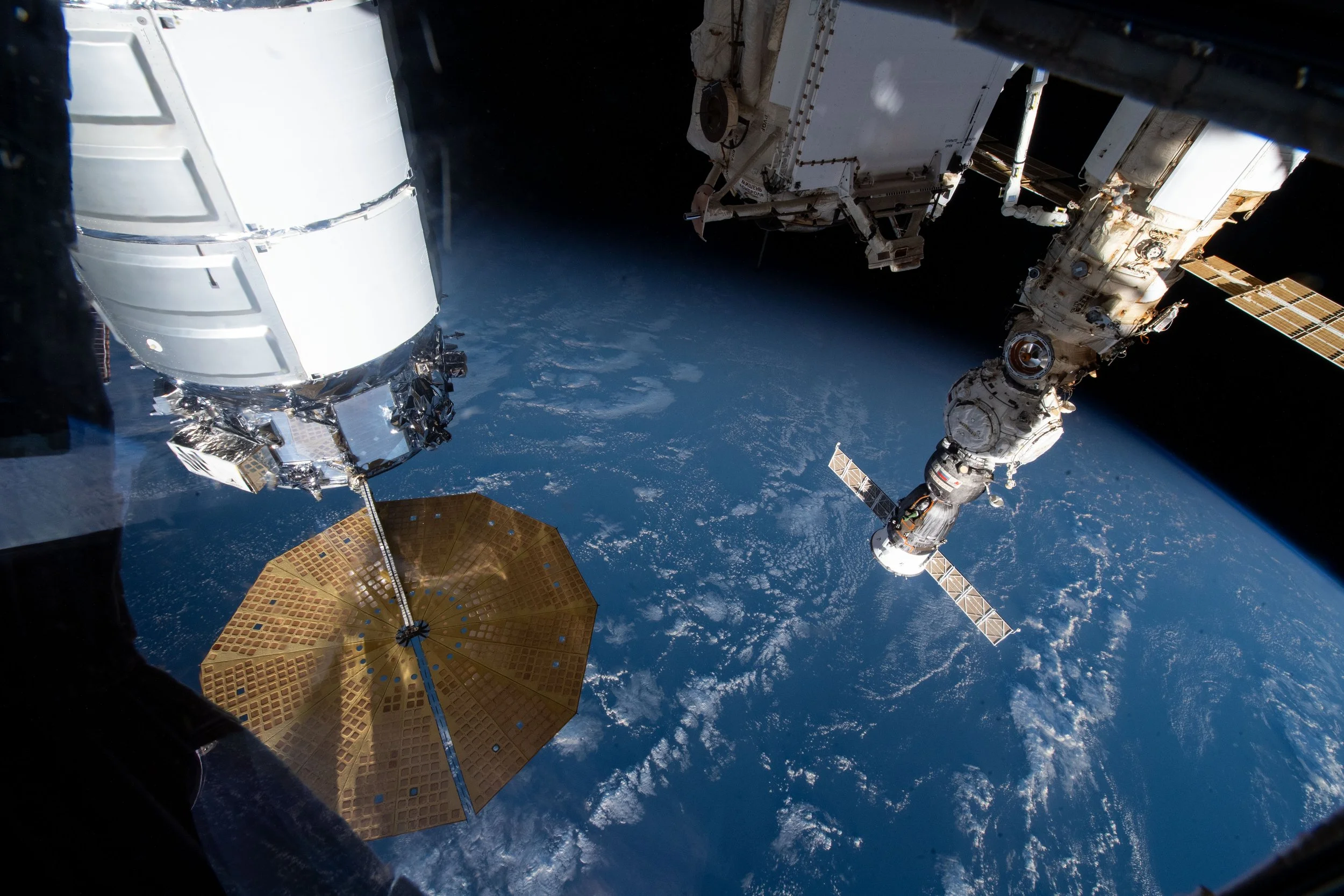
U.S. and Russian spaceships are pictured attached to the International Space Station as it orbited 267 miles above the Indian Ocean south of the island nation of Madagascar. (May 16, 2022) NASA@flickr.com
I had the opportunity to participate in the United Nations Office for Outer Space Affairs (UNOOSA) Space Law and Policy Conference in Vienna—an essential multilateral forum for examining the rapidly evolving challenges of space governance (1). What emerged across all panels was a community of practitioners, policymakers, engineers, and legal scholars who are simultaneously grappling with increasingly complex issues yet remain deeply committed to ensuring that outer space continues to be a safe, secure, and accessible domain for all States. The dramatic expansion and diversification of global space activity, combined with growing orbital congestion, has made it urgent to move from aspirational policy to operational practice. The 2025 United Nations Conference on Space Law and Policy, themed Operationalising Space Sustainability: Legal and Regulatory Approaches Across the Lifecycle of Space Debris, sought to understand how States can translate internationally endorsed guidelines—such as the Space Debris Mitigation and Long-Term Sustainability (LTS) Guidelines—into effective national norms and enforceable procedures(2). It also examined the contemporary applicability of the Rescue and Return Agreement (ARRA), focusing on the on-the-ground obligations that arise when debris or other space objects land on Earth, and how States can give practical effect to its provisions. The first panel confronted the persistent gap between the widespread endorsement of UN COPUOS space sustainability guidelines and their inconsistent implementation at national level. From our perspective, one of the clearest observations was the widening disparity between the normative clarity of the guidelines and their fragmented operationalisation in domestic law (3). The COPUOS instruments remain foundational, but without faithful and harmonised implementation, the orbital environment continues to degrade, and the risk of harmful interference increases. Divergent national approaches create uncertainty, invite loopholes, and disproportionately burden emerging spacefaring States and smaller actors that lack the resources to navigate a patchwork of disparate rules. The panellists were in broad agreement: while the guidelines remain a crucial international reference point, they must ultimately evolve into binding, performance-based regulations if they are to safeguard the long-term sustainability of the orbital environment. The panel’s call for stringent, harmonised operational requirements, including: binding performance-based regulations; strict end-of-life disposal obligations; manoeuvrability and trackability standards; transparent and rapid conjunction-notification procedures; clearer regulatory pathways for Active Debris Removal (ADR) and On-Orbit Servicing (OOS). These constitute the essential legal and technical foundations of an equitable and sustainable orbital ecosystem. Yet, sustainability measures must be designed to avoid creating prohibitive cost barriers that exclude developing States, scientific actors, and emerging industry members. The proposals for shared Space Situational Awareness (SSA), multinational monitoring initiatives, and sustained capacity-building resonate directly with our conviction that space is a global commons whose use must remain accessible to all humankind. Although the second panel received less public attention, it addressed the structural core of space governance: registration. Registration is not a procedural formality but the legal anchor that ties a space object to responsibility, jurisdiction, and transparency (4). The panel presented the findings of a comparative study across approximately fifty countries, revealing substantial divergences in legal definitions—such as “space object” and “launching State”—persistent misconceptions (including the erroneous belief by some States that military objects cannot be registered), weak inter-agency coordination, and limited awareness of notification obligations toward the UN. The newly launched Registration Toolkit aims to correct these inconsistencies by offering step-by-step guidance, case studies, and a UN-aligned submission template to support the establishment, maintenance, and modernisation of national registers. The Toolkit’s emphasis on digitalisation is especially welcome, as it will enhance transparency and interoperability across jurisdictions. UNOOSA’s announcement of a broader Space Law Toolkit, covering the full spectrum of national space legislation, marks an important step toward levelling the regulatory playing field. Equal access to legal knowledge and governance tools is indispensable for a fair and inclusive global space sector. The third panel shifted from law to culture, addressing how sustainability must become a habitual component of daily operational practice. Laws and guidelines alone cannot secure the orbital environment; sustainability must be embedded into engineering culture, mission design, operational procedures, and commercial decision-making. Several obstacles were identified as particularly urgent: insufficient access to high-quality SSA data; limited interoperability between operators; the lack of universally accepted “rules of the road”; and persistent uncertainty surrounding new legislative initiatives, such as the forthcoming EU Space Act. In my view, coordination—not technology—is the missing infrastructure of contemporary spaceflight. Even the most advanced AI-driven collision-avoidance systems cannot succeed without shared standards, transparent data exchange, and mutual trust among operators. The panel underscored the growing involvement of the insurance sector, which now recognises that sustainability is directly linked to risk. By recalibrating premiums to reward responsible actors and penalise unsafe conduct, insurers are inadvertently creating a market-driven incentive structure that aligns economic rationality with sustainability. This marks a significant cultural shift: responsible behaviour is no longer optional; it is becoming commercially advantageous. The session demonstrated that sustainability is simultaneously a technical challenge, a legal question, and a cultural transformation. Achieving meaningful reform will require transparency, regulatory convergence, and cross-sector cooperation. As a UN specialised agency headquartered in Geneva, WIPO occupies a central role at the intersection of innovation, law, and the global governance of technology. Its engagement with space activities, initiated in 1997, has grown markedly in relevance as the space sector undergoes extraordinary expansion. Patent filings relating to space technologies have multiplied dramatically, with space-transport-related patent families increasing sixfold between 2011 and 2023, and overall space-related activity expanding more than 500-fold. Patents—territorially granted exclusive rights for novel and inventive technical solutions—now underpin investment, technology transfer, and commercial partnerships in space. Yet the principle of territoriality, which anchors patent protection to specific jurisdictions, faces profound challenges in the transnational environment of outer space. Jurisdiction typically attaches through the State of registry under the Registration Convention, resulting in a complex mosaic of national patent laws, bilateral arrangements, and mission-specific agreements. The ISS Intergovernmental Agreement, particularly its Article 21 “quasi-territoriality” framework, is a prime example of how such gaps are managed in practice (5). Emerging governance initiatives, including the Artemis Accords and potential regional instruments such as an EU Space Act, signal a shift toward structured coordination. Yet, new technological realities complicate traditional patent doctrine: AI-assisted inventions challenge existing definitions of inventorship; export-control regimes struggle to define “technology” as innovation becomes increasingly intangible; and microgravity-enabled sectors—from biomedicine to advanced materials—raise questions regarding the balance between patent protection and the benefit-of-mankind principle that underlies space law. Legal tools already exist to navigate some of these tensions, such as Article 5ter of the Paris Convention (temporary use of patented inventions on foreign spacecraft) and 51 U.S.C. §20135, which treats space-launched objects as vehicles for U.S. patent jurisdiction. But these provisions reveal the limits of terrestrial IP frameworks when applied beyond Earth. Going forward, the development of comprehensive legal frameworks, strengthened WIPO-UNOOSA cooperation, and the emergence of space-related jurisprudence will be essential to reconcile territorial IP rights with the unique jurisdictional architecture of outer space. Perhaps the most human-centred discussions of the conference emerged from the panel on the Rescue and Return Agreement (ARRA). Originally drafted in the 1960s with astronauts and crewed capsules in mind, the ARRA now applies to increasingly frequent debris re-entry events, which directly affect communities on the ground. These incidents are no longer rare: debris has landed in Kenya, Brazil, India, South Africa, Ghana, and other States, often in rural areas where communities have no connection to space activities yet bear the risks associated with them. Brazil recounted a recent incident that required rapid inter-agency coordination and subsequently led to the integration of ARRA procedures into its national space legislation. Germany and ESA described historical cases, including the EXPRESS capsule (1995) and the Vega upper-stage tank (2016), highlighting the importance of timely communication channels and technical-diplomatic cooperation. Kenya’s experience with its 2023 debris event exposed gaps in SSA capability, public information protocols, and re-entry procedures, accelerating the development of its 2025 national space policy. South Africa recounted several historical debris events, including components from a Delta II rocket, and acknowledged that while its Space Affairs Act incorporates ARRA obligations, the framework requires modernisation to clarify compensation and incorporate sustainability. Experts emphasised that although ARRA lacks a formal definition of “space debris,” it has nonetheless evolved into a treaty of practical, operational significance, applied with increasing frequency in contemporary scenarios. One of the panellists underscored that its original objectives—to safeguard individuals in distress and to protect the technological integrity of space objects—remain fully pertinent within today’s environment of intensified activity and heightened risk. The Russian delegation observed that the continued absence of a universally accepted definition of space debris generates a degree of legal uncertainty, yet simultaneously reflects the inherently complex and rapidly evolving character of modern space operations. The panel made clear that the consequences of space governance are felt directly on Earth. Preparedness, SSA access, clear national procedures, and effective public communication are indispensable for ensuring safety and preventing misinformation. ARRA, despite its limitations, now functions as a global safety net—and as re-entries grow more common, its relevance will only increase.
Across both days of the conference, it became evident that the governance of outer space is at a decisive moment. Sustainability is no longer a peripheral concern but the organising principle of safe operations. Diplomacy remains the backbone of global governance. ARRA has become unexpectedly operational. Cross-sector cooperation is indispensable. Most importantly, these discussions challenge a dangerous misconception: that private actors operate in space as though they were acting within a terrestrial environment, exempt from legal consequences and insulated from the international responsibility borne by their respective States. Article VII of the Outer Space Treaty makes clear that States bear international responsibility for national space activities, whether conducted by governmental or non-governmental entities (6). It is therefore untenable to assume that private actors may wield technology more powerful than States, act in weightlessness without legal restraint, or impose risks on communities without accountability. Conferences such as this one help restore the balance between private innovation and public responsibility. Some participants expressed the view—common in parts of industry—that the OST is a “zombie treaty” that multilateral oversight impedes progress, or that commerce should be prioritised over governance. Such perspectives underscore why the role of UNOOSA, WIPO, COPUOS, and the broader multilateral system remains indispensable. Space, the “final frontier,” is a shared human endeavour. Its governance must reflect responsibility, solidarity, intergenerational justice, and a commitment to the rule of law.
BIBLIOGRAFY
1) United Nations General Assembly, Report of the Committee on the Peaceful Uses of Outer Space (A/78/20, 2023) para 12
2) UN Committee on the Peaceful Uses of Outer Space, Guidelines for the Long-Term Sustainability of Outer Space Activities (A/AC.105/2018/CRP.20).
3) Stephan Hobe, Cologne Commentary on Space Law: Volume 1 – Outer Space Treaty (2nd edn, Carl Heymanns 2022) 315–323.
4) Convention on Registration of Objects Launched into Outer Space (opened for signature 14 January 1975, entered into force 15 September 1976) 1023 UNTS 15.
5) Intergovernmental Agreement on the International Space Station (signed 29 January 1998) art 21.
6) Treaty on Principles Governing the Activities of States in the Exploration and Use of Outer Space, including the Moon and Other Celestial Bodies (opened for signature 27 January 1967, entered into force 10 October 1967) 610 UNTS 205, arts VI–VII.